
'Its internal economic rot and corrupt political elite have made the resurgent supremacy of the military establishment more invincible,' says Sunil Sethi.

'The continuing crisis in agriculture, the inability of successive governments to provide secure jobs to millions of youths having varying degrees of skills, and fragmentation of politics have created a sense of despondency.'

The middle class's long push to force the state to retreat from the economy may be reversing, says Ajit Balakrishnan.

'Alas, the Congress party offers no suggestions as to how to unscramble the omlette it cooked during 2004-2014 on which the Modi government may have since lavishly spread some tomato ketchup,' says Ambassador M K Bhadrakumar.

What the Indian economy looks like next January will influence her view on India, not her genetics, notes Shekhar Gupta.

'The army has stopped short of exerting the sort of influence it may have done historically.' 'It is comfortable with its relations with the civilian government as the superior partner.'
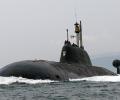
'We have been found seriously wanting in addressing our undersea warfare capability and China's emergence is a cause for concern.'

'The Reserve Bank's independence has remained a work in progress, an enduring challenge that the nation has been grappling with on an ongoing basis,' says RBI Deputy Governor Dr Viral Acharya.

'Our policy seems to be to give away part of J&K, even though we are entitled to the entire state.' 'The Congress has done so, and the BJP is following the same policy.' 'No one is applying their mind to the legal position.' 'Kashmir is not a part of Pakistan under its own constitution.'

Here's the full text of President Ram Nath Kovind's customary address to the joining sitting of Parliament on the first day of the budget session.
It is imperative that we deconstruct the current narrative and rewrite the storyline. To this end we need to alter the basic premise of the controversy, eliminate the obstructionists, home in on the true stakeholders and redefine the rules of engagement, says Vivek Gumaste.

With Beijing having had a profound rethink on India's admission as a full member of the Shanghai Cooperation Organisation, the tectonic plates of the geopolitics of a massive swathe of the planet stretching from the Asia-Pacific to West Asia are dramatically shifting. That grating noise in the Central Asian steppes will be heard far and wide -- as far as North America, says Ambassador M K Bhadrakumar.
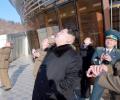
While trying to persuade North Korea to give up its provocative actions, engaging China is the first hurdle that world leaders will have to deal with, says Rajaram Panda.
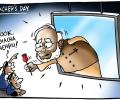
'Why does Mr Modi only attack Nehru from the Dynasty?' 'At one level, it is pure politics,' notes Shekhar Gupta.

'Xi Jinping is keen that the second Trump-Kim summit happens soonest.' 'Kim is reported to have told Xi that he expects to achieve a result from a second summit that the international community would welcome,' points out Dr Rajaram Panda.
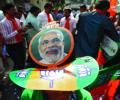
Retired senior US diplomats Teresita and Howard Schaffer believe the 'US cannot afford to continue restricting its contacts with Narendra Modi.' Rediff.com's Aziz Haniffa reports from Washington, DC.

North Korea is unlikely to strike first, but its response in retaliation, if attacked, could be massive even at the expense of its own destruction, says Rajaram Panda.
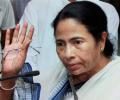
Banerjee along with other regional leaders are likely to play an important role in any future government in New Delhi, so it is in India's interest that regional leaders like herself realise the importance of progressive economics and good governance, says Tridivesh Singh Maini.

'The path to a resolution of the ethnic conflict is likely to be complicated and controversial with the majority Sinhalese community, and will become less likely if delayed.' 'It will certainly give Rajapaksa fresh political oxygen with which to revive himself and rally the opposition.'

Prime Minster Narendra Modi's op-ed in the German daily Frankfurter Allgemeines talks about development, New Age India and his 'Make in India' campaign. Here's the complete text of the column.

China has relaxed its one-child policy and further freed up markets in order to put the world's second-largest economy on a more stable footing.
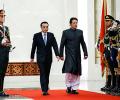
'Imran cannot escape responsibility for providing a mask to the Pakistan army to engage in unlawful activities and to wage aggression after India retaliated to the terrorist attack,' says Ambassador T P Sreenivasan.

'The situation in the country is very scary.' 'There is an increasing attack on the Constitutional democratic rights of our people.'

Higher education policy may be at the core of the Tamil Nadu assembly polls next May, with a potential to break the ties between the ruling AIADMK in the state and the BJP counterpart at the national level, says N Sathiya Moorthy.

FY16 GDP growth was seen at 7.5%, against 8.1-8.5% earlier.

The plan of UID/Aadhaar-based surveillance does not end with the collection of fingerprints and iris scan, it goes quite beyond it and poses a lethal threat to the idea of India, says Gopal Krishna.
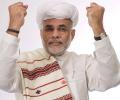
Two former senior United States diplomats, with more than 60 years experience in South Asia between them, have exhorted Washington to establish communication with Bharatiya Janata Party's prime ministerial candidate Narendra Modi sooner than later.
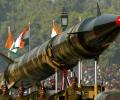
'We have worked to create road blocks in the path of those who thought that there was space for conventional war despite Pakistan's nuclear weapons.' 'Pakistan's nuclear weapons programme is not open-ended and aligned with India only.' 'In this unstable regional environment, one nuclear power is trying to teach lessons to another nuclear power through the medium of small arms and mortar shells on the Line of Control, and bluster.' 'A historic opportunity of a lifetime beckons the leaderships of India and Pakistan to grasp, sit together and explore the possibilities of conflict resolution.'

'The US wants Modi to succeed because we want India to succeed. For our part, when India thinks of its partners in the world, we want it to think of the US first. That means positioning our country as the preferred provider of the key inputs that can help to propel India's rise.' 'The meeting between Modi and Obama is, and must be, an opportunity for true strategic dialogue -- not a scripted exchange of talking points, but an open discussion of the big questions. What kind of world do we want to live in? What are our true priorities? And most importantly, why does this partnership still matter?'

Modi accused opponents of trying to pit one section against the other while his government is working towards taking all people along

If the aim is to become a player with some strategic space of its own, not just in the Indian Ocean region but also in the adjoining region, then greater interaction with China is desirable, even necessary.

How will the Modi Sarkar's likely return affect other nations?
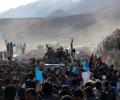
If Afghanistan is going to make any gains through democratic reforms, the newly elected president must start with addressing corruption at all levels of government and developing a comprehensive government financing plan independent of American support.

Inflation is down and there's every chance that crude prices will be subdued through the next year.

The Niti Aayog has finalised the first draft of a new national energy policy.

'It is a tense border and there are numerous elements that keep these tensions alive.' 'India is willing to militarily respond if provoked.'
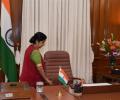
Sushma Swaraj, like Clinton, has a strong political base in her own party and is likely to have her imprint on foreign policy, says Ambassador T P Sreenivasan.

Capital flows have become much more skittish and volatile during this period, with short-term horizons dominating allocations.

Biometric authentication is based on the unscientific and questionable assumption that there are parts of human body that does not age, wither and decay with the passage of time.

Even if they score administratively, state governments ruled by the party suffer from an inability to communicate positively, say observers.
